Infidel Poetics: Riddles, Nightlife, Substance by Daniel Tiffany
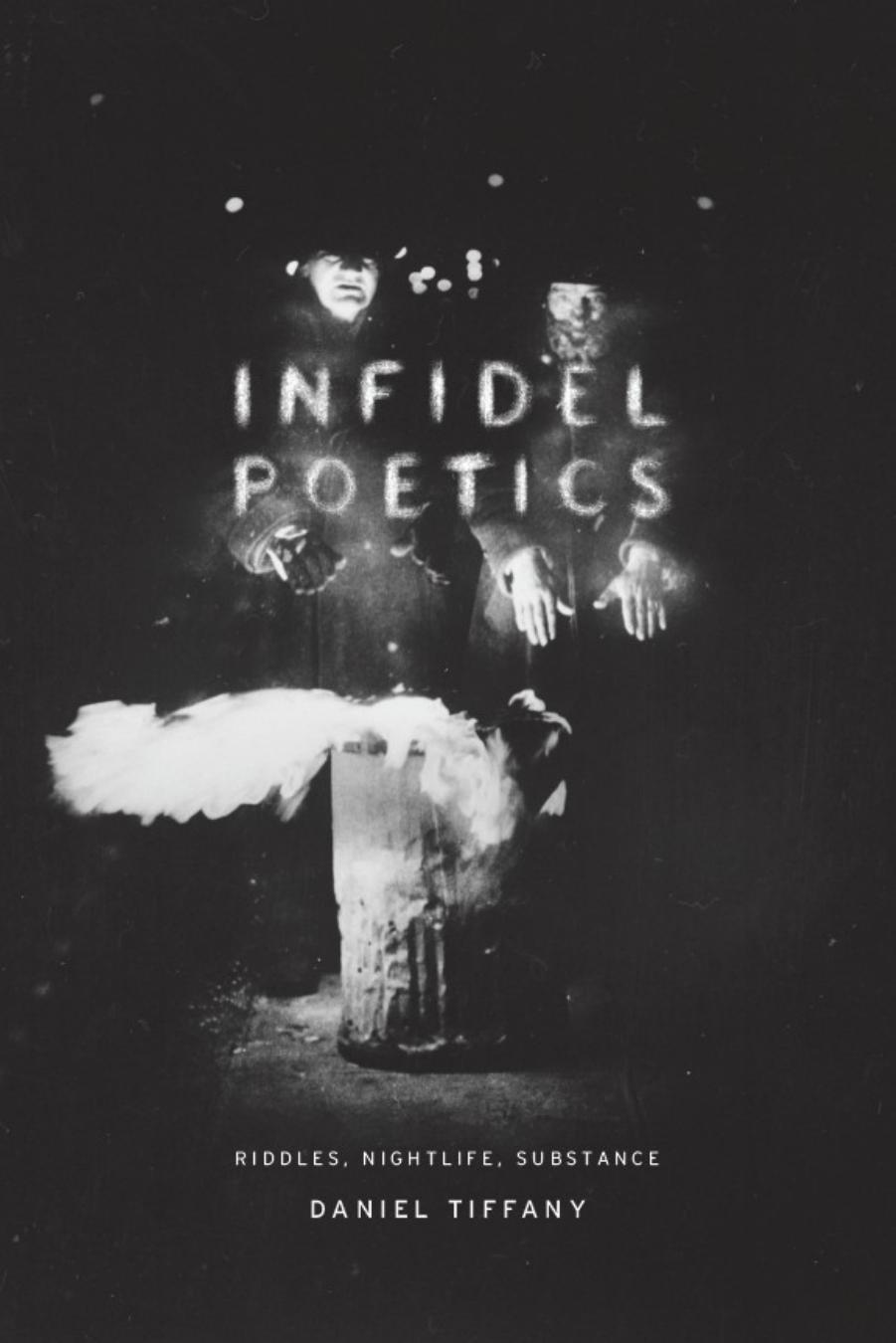
Author:Daniel Tiffany
Language: eng
Format: epub, pdf
Publisher: The University of Chicago Press
* * *
1. G. W. Leibniz, “The Principles of Philosophy, or, the Monadology” (1714), in Philosophical Essays, by G. W. Leibniz, ed. and trans. Roger Ariew and David Garber (Indianapolis: Hackett, 1989), 213.
2. Leibniz, “Monadology,” 215.
3. Leibniz, “Monadology,” 213.
4. G. W. Leibniz, “Principles of Nature and Grace, Based on Reason,” in Philosophical Essays, 207.
5. Baumgarten’s essay can be found in a selection of his writings: Reflections on Poetry, trans. Karl Aschenbremer and William Holther (Berkeley and Los Angeles: University of California Press, 1954).
6. Were one to seek a contemporary analogy for Leibniz’s influence over the Jena Circle and its followers, one would want to consider the fascination exercised by Wittgenstein’s thought over certain contemporary writers (and scholars) associated with the school of Language Poetry. Marjorie Perloff’s book Wittgenstein’s Ladder (Chicago: University of Chicago Press, 1996) offers both an illustration and an exposition of Wittgenstein’s appeal to post-Objectivist sensibilities. The “Wittgenstein effect” in contemporary poetry emanates, like the Romantic vortex around Leibniz, from an eccentric conjugation of poetry and logic—though certainly this recent episode is less momentous in its effects than the earlier doctrine of “poetic logic” (Hölderlin’s phrase). Wittgenstein was, after all, essentially a logician, whose early thinking was influenced (via his teacher, Bertrand Russell) by Leibniz.
7. Indeed, Peter Fenves adds, the Theodicy (1706) was dedicated to the recently deceased queen of Prussia, daughter of Leibniz’s most important patron, the Electress Sophia. The queen of Prussia was also the recipient of letters outlining Leibniz’s conception of “clear but confused perception,” the nucleus of his theory of monadic obscurity. Fenves, Arresting Language: From Leibniz to Benjamin (Stanford, CA: Stanford University Press, 2001), 289–290 n. 91.
8. Catherine Wilson, “The Reception of Leibniz in the Eighteenth Century,” in The Cambridge Companion to Leibniz, ed. Nicholas Jolley (Cambridge: Cambridge University Press, 1995), 467.
9. Etienne Bonnot de Condillac cited in Wilson, “Reception of Leibniz,” 455.
10. Hegel cited in Fenves, Arresting Language, 284 n. 68; Bertrand Russell, A Critical Exposition of the Philosophy of Leibniz (1900; London: George Allen, 1937), xiii.
11. The role of the idea of philosophical style in Leibniz’s thought is carefully delineated by Fenves in the first chapter of his book Arresting Language, 13–32.
12. Friedrich Schlegel’s “Lucinde” and the Fragments, trans. Peter Firchow (Minneapolis: University of Minnesota Press, 1971), Athenaeum frag. 220. All references to fragments use the numbering of this collection.
13. Schlegel, Athenaeum frag. 206.
14. Schlegel, Lyceum frag. 96.
15. On the origin and historical vicissitudes of Leibniz’s theory of unconscious perception (which has no mechanism of repression), see Jonathan Miller, “Going Unconscious,” New York Review of Books, 10 April 1995.
16. Walter Benjamin discusses these adaptations of monadological principles in his dissertation, “The Concept of Criticism in German Romanticism,” reprinted in Selected Writings, vol. 1, 1913–1926, by Walter Benjamin, ed. Marcus Bullock and Michael W. Jennings (Cambridge, MA: Harvard University Press, 1996), 134–135, 147.
17. Georg Lukacs, “Die Subjekt-Objekt Beziehung in der Ästhetik,” Logos, 1917–1918, 14–28.
18. Richard Herbertz, Die Lehre vom Unbewussten im System des Leibniz (1905; repr., New York: Olms, 1980).
19. The monadological
Download
Infidel Poetics: Riddles, Nightlife, Substance by Daniel Tiffany.pdf
This site does not store any files on its server. We only index and link to content provided by other sites. Please contact the content providers to delete copyright contents if any and email us, we'll remove relevant links or contents immediately.
4 3 2 1: A Novel by Paul Auster(12391)
The handmaid's tale by Margaret Atwood(7762)
Giovanni's Room by James Baldwin(7345)
Asking the Right Questions: A Guide to Critical Thinking by M. Neil Browne & Stuart M. Keeley(5772)
Big Magic: Creative Living Beyond Fear by Elizabeth Gilbert(5771)
Ego Is the Enemy by Ryan Holiday(5445)
The Body: A Guide for Occupants by Bill Bryson(5096)
On Writing A Memoir of the Craft by Stephen King(4942)
Ken Follett - World without end by Ken Follett(4731)
Adulting by Kelly Williams Brown(4574)
Bluets by Maggie Nelson(4553)
Eat That Frog! by Brian Tracy(4535)
Guilty Pleasures by Laurell K Hamilton(4448)
The Poetry of Pablo Neruda by Pablo Neruda(4105)
Alive: The Story of the Andes Survivors by Piers Paul Read(4031)
White Noise - A Novel by Don DeLillo(4009)
Fingerprints of the Gods by Graham Hancock(4003)
The Book of Joy by Dalai Lama(3986)
The Bookshop by Penelope Fitzgerald(3852)
